Lighthouse opens doors to a brighter future

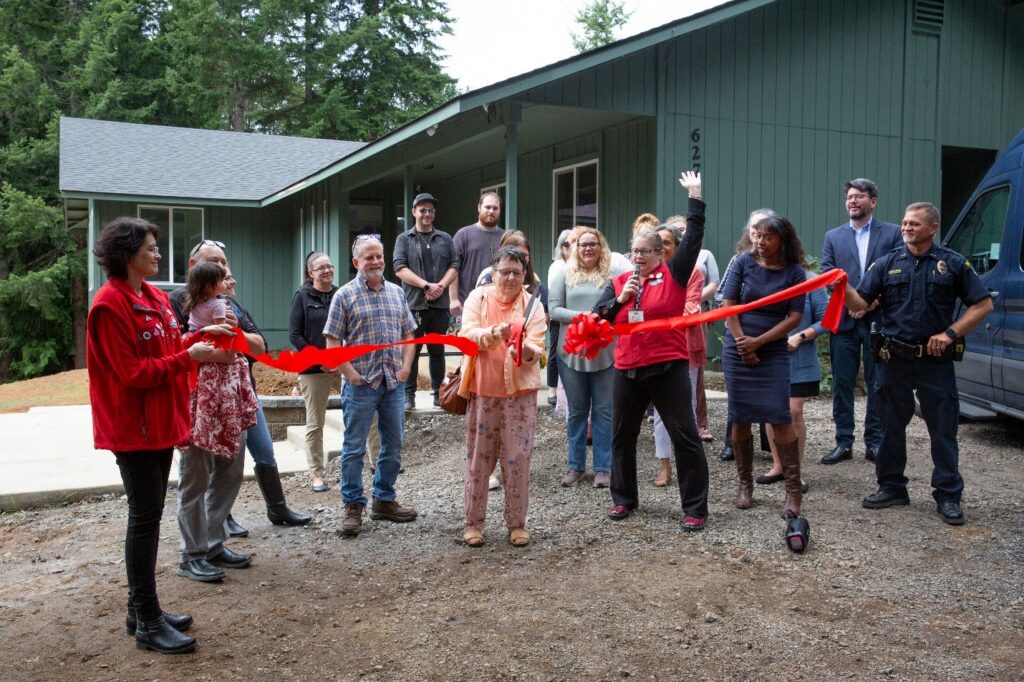
COOS BAY, Ore. — Community partners gathered September 15th to celebrate the opening of Lighthouse, a new Alternative Youth Activities housing program in Coos Bay for young families and pregnant youth experiencing homelessness.

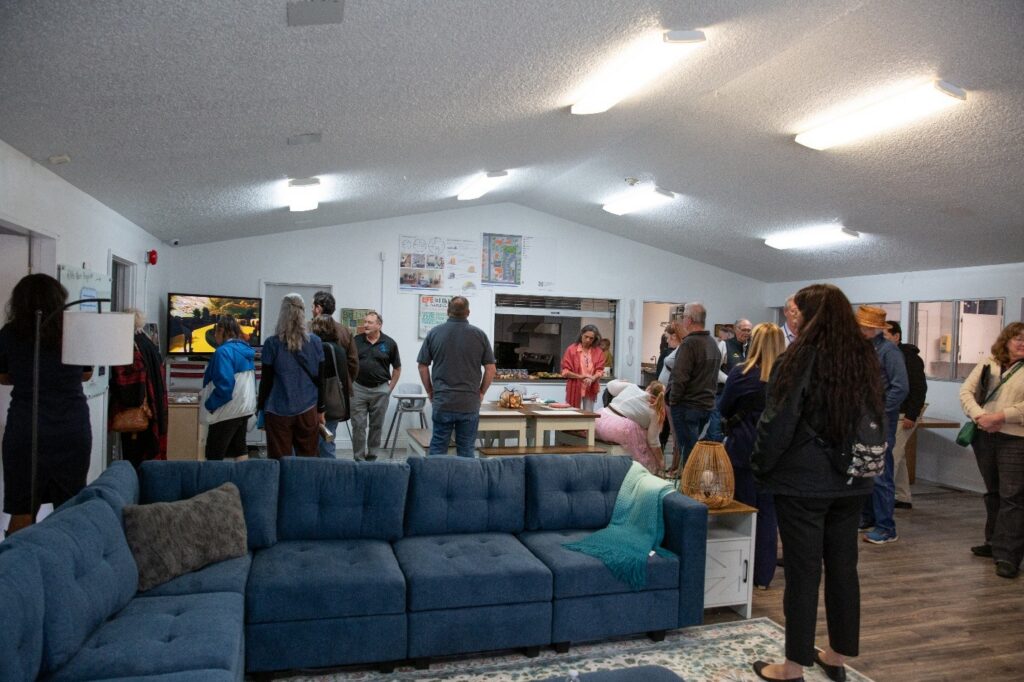
Located at the former Belloni Ranch on Karl Road, Lighthouse includes 10 residential units with capacity for up to 24 beds. The program will give young people and their children a safe, stable place to live while connecting them with services and resources that can help them move toward permanent housing.

The opening was celebrated in conjunction with the Northwest Indian Housing Association Fall Conference at Ko-Kwel Casino Resort. Oregon Housing and Community Services Executive Director Andrea Bell joined conference attendees and local partners for the occasion. Following the conference luncheon, attendees, project partners, and community representatives traveled to Lighthouse for a ribbon-cutting and tour.

“The Coquille Indian Housing Authority Board of Commissioners was very pleased to have the opportunity to join with the State of Oregon, Coos County, City of Coos Bay, and Alternative Youth Activities in creating Lighthouse, a transitional housing facility for homeless youth,” shared Rocky Doyle, Chair, Coquille Indian Housing Authority Board of Commissioners.  “It was gratifying to be able to reach beyond our own housing needs and, in the Coquille Tribe’s spirit of giving, make a positive contribution to the wider community.  Hopefully, there will be many more opportunities for us all to work together.” 

The Bay Area Chamber of Commerce hosted the ribbon-cutting. Participants included representatives from Alternative Youth Activities (AYA), the Coquille Indian Housing Authority, Oregon Housing and Community Services, Coos County, the City of Coos Bay, the Northwest Indian Housing Association, and the surrounding community.

AYA’s collaboration with its Tribal, state, county, and city partners made Lighthouse possible. The Coquille Indian Housing Authority supported the project with funding from the BAFI NATO Initiative–Native American Tribes of Oregon. Coos County facilitated AYA’s purchase of the Karl Road property, and state and local housing resources supported the development of additional shelter capacity.

“OHCS is grateful to be in partnership with Tribal leaders centered on sovereignty, trust, and our responsibility to ensure that housing progress directly serves Tribal and rural communities,” said OHCS Executive Director Andrea Bell. “Under the leadership of Gov. Kotek, state resources are supporting locally-driven solutions in ways people can see and feel. As we look to the future mindful of the past, the value and vibrancy of rural Oregon is showing how to get things done that materially make life better in our state.”

The project shows what can be accomplished when Tribal, state, local government, and nonprofit partners coordinate their resources around a shared community need. Lighthouse will give young families and pregnant youth a stable place to stay while they work toward permanent housing and greater independence.

AYA’s Board Chair, Alice Carlson shared “Supporting youth as they move into adulthood has been a long-held mission for AYA.  The Lighthouse program gives us 12 to 24 months to help young families build lasting stability and break the cycle of generational poverty.”

How the Coquille Indian Tribe is working to restore Chinook and protect its traditions

To rebuild the Coquille River’s struggling run, the tribe and state are removing invasive predators and raising young salmon.

Starting around 2018, salmon returns in many of Oregon’s coastal rivers crashed.

“There was a sharp drop-off, kind of coast wide, and over the next couple of years, other coastal basins recovered,” said Ed Hughes, the Oregon Department of Fish and Wildlife’s acting fish district biologist in Charleston. “But in the Coquille here, they didn’t bounce back.”

Hughes said the Coquille’s failure to rebound helped biologists connect the decline to invasive smallmouth bass, which prey on young salmon. Warmer river temperatures, low flows and changing ocean conditions have also hurt salmon survival.

The state wildlife agency brought its concerns to the tribal council, said Brenda Meade, chair of the Coquille Indian Tribe.

“We talked a lot about what the issues were and how we were going to fix it,” Meade said.

In 2022, the tribe and the state formalized a co-management agreement covering fish and wildlife across five southwest Oregon counties.

Their work has included removing invasive bass, improving the collection of adult salmon for breeding and expanding hatchery efforts. In 2022, they also developed a conservation hatchery program to rebuild the Coquille’s wild fall Chinook population.

Read or listen to the full story from Jefferson Public Radio

IHS Awards $3.5 Million for Tribal Food and Nutrition Initiatives

The U.S. Department of Health and Human Services, through the Indian Health Service, has awarded $3.5 million to 14 Tribal and urban Indian communities to establish and implement community-driven produce prescription programs across Indian Country.

The Phase 2 funding provides up to $250,000 to each of the 14 participating Tribes, Tribal organizations and urban Indian organizations. Recipients include the Chickasaw Nation, Coquille Indian Tribe, Sault Ste. Marie Tribe of Chippewa Indians, Swinomish Indian Tribal Community, Tunica Biloxi Tribe of Louisiana and Yukon-Kuskokwim Health Corporation, as well as four urban Indian organizations.

Native News Online – September 22, 2026

Yahoo! News – September 23, 2026

Port of Bandon returns memorial site to Coquille Indian Tribe

The Port of Bandon has agreed to return a quarter-acre memorial site in Old Town to the Coquille Indian Tribe, transferring ownership of land where a Coquille village stood.

Tribal council members, elders and children joined port commissioners Sunday at the Nasomah Memorial to mark the transfer.

The port has owned the property for decades and has leased it to the tribe under a 99-year agreement. Commissioners voted unanimously in July to give the land to the tribe.

“Transfer of title is what it is,” Port Commission President Reg Pullen said. “It’s a gift, and the tribe has been great partners with us. We’ve endeavored in several ventures together, and I hope that we’ll do more in the future.”

Pullen said he expects the title transfer to close within a month.

Tribal Council Chair Brenda Meade said the presence of several generations at the gathering was deliberate.

“We have elders here to witness, and we have young people here to witness,” Meade said. “It’s really important to see that, because that’s how important it is to be recognized by others.”

Jefferson Public Radio – September 15, 2026

Lincoln Chronicle – September 17, 2026

Federal Court Upholds Coquille Indian Tribe’s Medford Land and Gaming Decision

Coos Bay, OR — A federal judge in Washington, D.C. has ruled in favor of the Coquille Indian Tribe, upholding the U.S. Department of the Interior’s decision to place approximately 2.4 acres in Medford, Oregon into trust for the Tribe and to authorize gaming there. In a memorandum opinion issued today, September 4, 2026, U.S. District Judge Amit P. Mehta denied the challenge brought by the Cow Creek Band of Umpqua Tribe of Indians, the Karuk Tribe, and the Tolowa Dee-ni’ Nation, and granted summary judgment to the federal government and to the Coquille Tribe, which had joined the case to defend the decision.

The lawsuit challenged Interior’s January 2025 approval on several grounds, and the court rejected each argument. Central to the ruling was the Coquille Tribe’s Restoration Act of 1989, which restored the Tribe’s federal recognition and authorized the Secretary of the Interior to take land into trust within the Tribe’s five-county service area — Coos, Curry, Douglas, Jackson, and Lane. Because the Medford property sits within that service area, the court agreed the land qualifies as “restored lands” under the Indian Gaming Regulatory Act, meaning gaming is permitted there.

Chair Brenda Meade stated, “Today a federal judge confirmed what we have always known, that the Coquille Restoration Act allows us to provide for our citizens and rebuild our economy in the five counties identified by Congress. This ruling ensures our sovereignty is stronger than ever.”

Full Press Release – September 4, 2026

Rogue Valley Times – September 4, 2026

KCBY-TV (via MSN) – September 6, 2026

KEZI-TV – September 7, 2026

CDC Gaming Reports – September 7, 2026

US Laws website – September 4, 2026

KOBI-TV – September 9, 2026

Tribal Business News – September 9, 2026

KTVL-TV – September 10, 2026


Progress is slow to replace dozens of offensive place names in Oregon

Under a state law passed in 2025, 90 names are up for replacement. Only two have been officially changed so far.

Content warning: The following story contains reporting on place names that currently utilize racial and ethnic slurs through the use of anti-Indigenous, anti-Black, anti-East Asian, anti-Brown, anti-European, anti-Roma, anti-Italian/Spanish/Portuguese and classist offensive language.

For decades, Native people have pushed to remove Oregon’s derogatory place names. Current renaming efforts are moving forward with minimal tribal involvement.

“It’s been decades of work, not just for the state, but for the tribes,” said Brenda Meade, Chairwoman of the Coquille Indian Tribe. “If they are concerned about the tribes not engaging, it’s because it’s so cumbersome of a process.”

Meade continued, “I don’t know if the process is broken or there’s just so many layers of bureaucracy to some of these things, but any time there [are] things that reflect the bad part of our history, it’s something that needs to go away.”

A year after the passage of the state Dignity In Place Act, aimed at replacing derogatory names, few official names have been changed.

Underscore Native News and Oregon Public Broadcasting – August 24, 2026

Yahoo! News – September 4, 2026


Life-saving donation comes from a caring coalition

What equated to a truckload of life-giving opportunities arrived at the front door of the Ko-Kwel Wellness Center on River Road in Eugene on July 15. A donation that crossed state borders and came from donors spanning a variety of cultural and economic demographics, just like the people they are hoping to save.

It arrived locally to the Reveille Foundation, a non-profit organization, whose mission is to help veterans and underserved people rebuild from the ground up, starting with stabilized housing, and staying through holistic healing. But the donation’s origin started much further away, through other connections to Reveille’s leadership.

“Every one of these donated kits represents an opportunity to save a life and connect someone to recovery,” said Ko-Kwel Wellness Center OTP Director Colleen Wray. “We are deeply grateful to the Reveille Foundation, and their partners, for their generous support. Partnerships like this allow us to expand overdose prevention efforts, increase access to Narcan, and continue educating our community that addiction is a treatable medical condition—not a moral failing.”

READ FULL PRESS RELEASE – July 21, 2026

RFQ – Healthcare Benefits Program Assessment and Strategic Consulting Services

The Coquille Indian Tribe (CIT) is seeking Statement of Qualifications submissions from qualified and experienced individuals or firms to conduct a comprehensive healthcare benefits program assessment and provide strategic consulting services. The purpose of this solicitation is to secure information from qualified entities with experience in conducting comprehensive healthcare benefits assessments and providing strategic recommendations and implementation planning services. Upon completion of the RFQ, the Tribe expects to perform a targeted solicitation from qualified entities responding to this RFQ for the specific services.

CIT will accept responses to the RFQ until 2 p.m. PST on Thursday, August 6, 2026.


See the Request for Qualifications (RFQ) here

Coquille Tribe celebrate resilience, practice remembrance for Restoration Day

The Coquille Tribe welcomed policy makers, elders and tribal members spread across the country to celebrate what is described as the most joyful day on the calendar, Restoration Day. The entire weekend leading up to the June 28 holiday becomes a festival honoring tribal culture, traditions and progress…

Read more in The World

The World Newspaper – July 8, 2026

Community connector: Economic development director aligns tribal priorities with local needs

An enrolled member of the Coquille Indian Tribe, David Hill works for Tribal One, the tribe’s business and economic development arm, serving as a community liaison for the tribe’s Ko-Kwel Wellness Center and other economic development initiatives. 

People are the heart of Lane County — which is why, each week, Lookout Eugene-Springfield will profile someone who is working behind the scenes to make our community better. 

This week, they profile David Hill.

Lookout Eugene-Springfield – June 23, 2026